
Jefferson Release Date Labels
A source label defines what the date proves. An actual release date looks backward to a completed end-of-custody event. A projected or tentative release date is an administrative forecast. A full-term date reflects sentence expiration under a particular computation. A parole eligibility date marks a possible legal point for consideration, while a hearing date only schedules a proceeding. None of the future-facing labels proves that a person left a facility.
Jefferson Parish Correctional Center is primarily pretrial. Many people there do not have a sentence from which a projected release date can be calculated. Bond satisfaction, a court order, another hold, and jail processing may control their exit. A parish sentence begins with JPSO and the sentencing court. A Louisiana DPS&C sentence requires the state time computation, even if part of the custody took place in a parish facility.
Locate Jefferson Inmate Release Dates
First decide which agency has legal custody. Physical location alone can be deceptive because a state prisoner may be housed locally, and a JPCC departure can be a transfer rather than release to the community. Preserve the CCN, DOC number, court case number, full name, date of birth, and sentence dates. Those identifiers also prevent two bookings or two people with the same name from being merged.
- Obtain the sentencing minutes and commitment order for every case. A pending pretrial case may not yield a sentence date at all.
- Confirm whether JPSO or Louisiana DPS&C has legal custody. Record both the CCN and DOC number when both systems are involved.
- For a state sentence, call the DPS&C Imprisoned Person Locator at 225-383-4580 with the DOC number, or name and date of birth, and request the exact “projected release date (if applicable)” field.
- For a parish sentence, ask JPSO and the sentencing court for the current time-computation and release records. Do not calculate from the charge or bond line.
- Ask whether the date includes diminution, presentence credit, concurrent or consecutive terms, forfeitures, and any other hold.
- After the predicted date, obtain the actual release or discharge record and identify any receiving authority.
Louisiana’s official inmate-information page describes the telephone locator fields. The public locator is VINELink-based and may not display the projected field on every record. A missing field should remain missing. Ask for the official computation instead of filling the gap with arithmetic.
Jefferson Release Dates by Custody
Different records answer different questions. The current JPSO roster shows people now listed in parish custody, not a history of release dates. Louisiana VINELink can show a status and date when the reporting agency supplies them, yet its fields vary. A court record can show legal authority without proving the exact moment jail staff completed the exit.
| Custody situation | Best date source | Main limit |
|---|---|---|
| JPCC pretrial detention | JPSO release record plus court minutes | No sentence-based projection may exist |
| Jefferson parish sentence | JPSO computation and sentencing court | Other holds can block physical departure |
| Louisiana state sentence | DPS&C computation and locator | Public VINELink may omit the projected field |
| Parole consideration | Committee docket, minutes, and DPS&C record | Eligibility or a grant is not release |
| Federal sentence | BOP locator and federal case record | BOP data does not answer ordinary JPSO custody |
| Immigration transfer | JPSO destination record and ICE channels | Leaving JPSO may start a new custody period |
The Jefferson Parish release-record path covers the full evidence chain when a person has already left the live jail roster. Absence from that roster is not an actual release date.
Louisiana Release Date Credits
Louisiana calls sentence reduction through earned credit diminution of sentence. The applicable rule depends strongly on the offense date and sentence class. For offenses committed on or after August 1, 2024, La. R.S. 15:571.3.1 allows an eligible felony offender in parish prison or DPS&C custody to earn up to a maximum of 15% of the particular sentence. It excludes specified sex-offense and habitual-offender sentences, does not apply good time to presentence credit, and leaves earning decisions to the secretary.
For earlier offenses, R.S. 15:571.3 contains several different regimes. Some parish sentences without hard labor use 30 days of diminution for 30 days actually served. Certain first violent cases use three days for 17 days. Other eligible DPS&C categories can use different ratios. Offense date, violent or sex-offense status, habitual-offender status, revocation dates, and amendments all matter.
The often repeated “85 percent” phrase requires care. The new 15% maximum reduction means a person who earns the full amount and has no other adjustment may serve at least 85% arithmetically. That does not make 85% a universal rule. It does not apply to pretrial detention, excluded classes, or every older sentence. Under R.S. 15:571.5, part of a good-time release may also be served as unsupervised parole. A gate release is therefore not always an unconditional discharge.
Forfeiture is another reason the date can move. R.S. 15:571.4 governs loss of diminution in the circumstances it covers. Restoration and agency corrections can also alter the computation. Program credit, where authorized, is a separate input and should appear in the official record. None of these figures should be assumed from the sentence length. Ask the responsible sheriff or DPS&C to state the current credit, forfeiture, and restoration treatment in the particular computation.
Note: Use the statute tied to the actual offense and sentence; a familiar rate from another case cannot safely predict a Jefferson release date.
Why Jefferson Release Dates Change
A release forecast is a live administrative calculation. It can move when staff receive a new court order, correct a sentence, apply a credit, restore or forfeit diminution, or add another lawful term. The table identifies the kinds of facts to ask about, not a formula for recalculating the date at home.
| Factor | Possible effect | Verification source |
|---|---|---|
| Presentence jail credit | Changes credited time where legally recognized | Commitment order and official computation |
| Concurrent or consecutive terms | Alters how multiple sentences run | Sentencing minutes for every docket |
| Earned diminution | May reduce the term for an eligible person | DPS&C or sheriff computation |
| Disciplinary forfeiture or restoration | Can move the forecast later or earlier | Custodian’s updated time record |
| Amended sentence or correction | Replaces a prior computation input | Court order and corrected agency record |
| Detainer or other jurisdiction | May redirect custody instead of release home | Hold and destination records |
| Parole decision | May create a conditional path, subject to processing | Committee minutes and DPS&C release record |
A detainer is a request or legal basis for another authority to assume custody. It explains why the sending agency’s end date may be real while the person is not in the community. Always ask for the destination.
Jefferson Parole Date Limits
Parole eligibility follows a separate body of law from diminution. R.S. 15:574.2 and R.S. 15:574.4 include offense-date rules, listed exceptions, and legacy categories. Eligibility means the person may be considered if all legal conditions are met. It is not a release promise.
The Committee on Parole docket shows a planned hearing. Minutes show the decision. A grant can still be followed by conditions, processing, rescission issues, or a different hold. After any favorable decision, check the DPS&C status and actual release record. If supervision begins, verify the assigned district rather than assuming the Jefferson office applies because the arrest occurred in the parish.
Jefferson Release Date Notifications
Louisiana operates two services that should not be merged. LAVNS is the Louisiana Automated Victim Notification System delivered through VINELink. LAVO is the Louisiana Victim Outreach Program. DPS&C says local LAVNS registration does not also register a person for LAVO. LAVO may provide state-prison notices that include initial housing, projected release information, sentence-changing rulings, transitional-work assignment, and release by any means.
The DPS&C victim-services page shows this Louisiana-specific distinction.
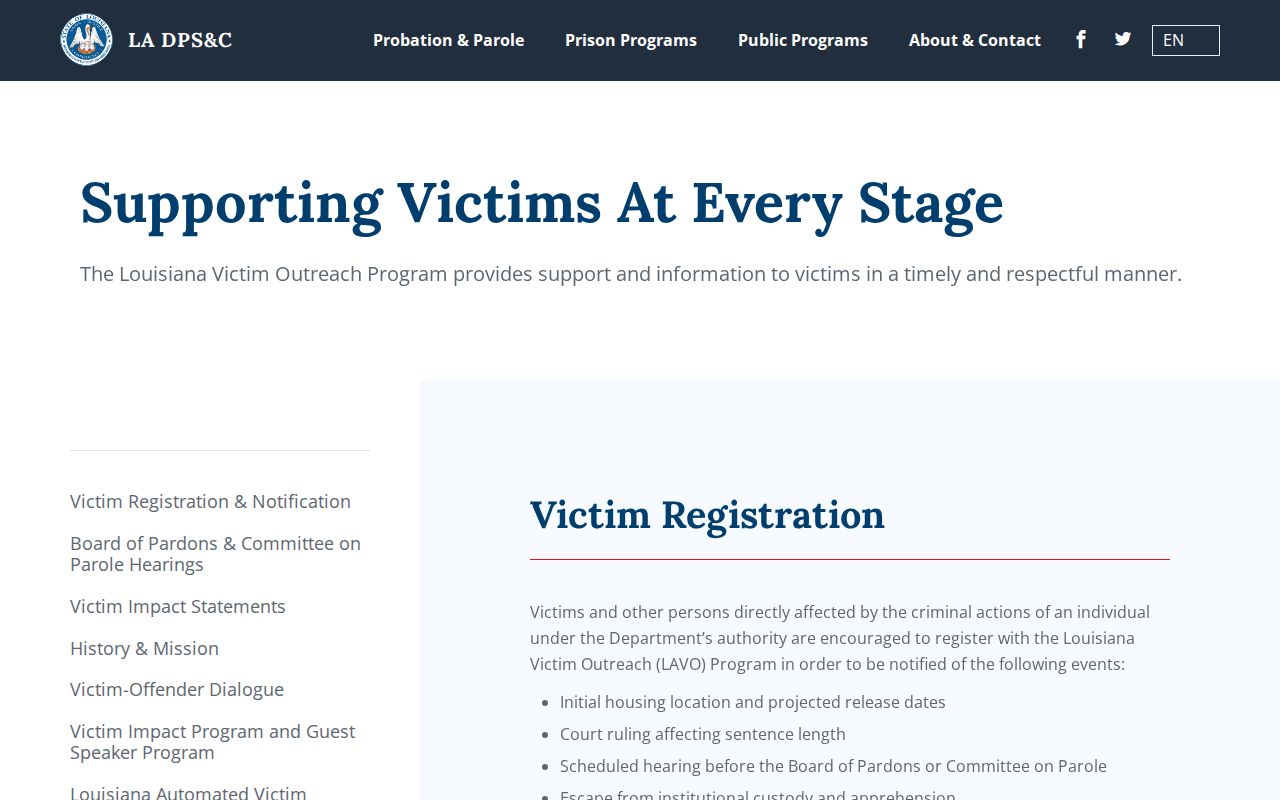
The captured page supports using the correct registration path and prevents a VINELink signup from being mistaken for LAVO enrollment.
Confirm Jefferson Actual Release
Near the predicted day, ask for a fresh computation. After the day passes, obtain the historical event record. For JPCC, request the actual release time, release authority or type, any hold, and destination. For a state sentence, ask DPS&C for the actual release or discharge date and whether community supervision follows. A VINE alert is useful, but it remains an informational notice supplied by a reporting agency.
The VINELink Release Check can help monitor a specific record. When an alert arrives, read the named agency and event label, preserve the time received, and confirm the event with that custodian. If sources disagree, report the conflict and seek a corrected record. Do not select the date that seems most convenient.
For a Jefferson Parish event, a tailored request should identify the full name, date of birth, CCN, booking date, court number, and approximate release period. Ask for the admission date and time, actual release date and time, release authority or type, destination or receiving agency, any hold disposed at release, and correction notation. Not all items are necessarily held in one public document, and exemptions or redactions may apply. The list describes the records sought; it does not claim the standard incarceration letter contains every field.
JPSO’s current roster has a page-level update time but no released-person archive or promised refresh interval. A former row’s disappearance cannot supply an event time. Court minutes may explain bond, dismissal, time served, or sentencing authority, yet an additional hold can still delay or redirect departure. For that reason, both the court order and custodian’s completed-event record are needed when the exact actual date matters.
Federal and immigration paths also require care. The BOP locator may show “Released” or “Not in BOP custody” with a federal release date, but that event does not rule out later state, parish, USMS, or immigration custody. ICE’s locator is chiefly a current detention tool, so no match can reflect several events besides release. When JPCC records a transfer, follow the named receiving authority and keep the sending and receiving dates distinct.
- Projected date
- An estimate produced from the current sentence computation.
- Actual release
- The completed event when one custodian ended physical control.
- Discharge
- The legal end of a sentence or supervision status, as the record defines it.
- Transfer
- An end of one agency’s custody followed by another agency’s custody.